
The Architectural Barriers Act: The Law That Opened America’s Doors

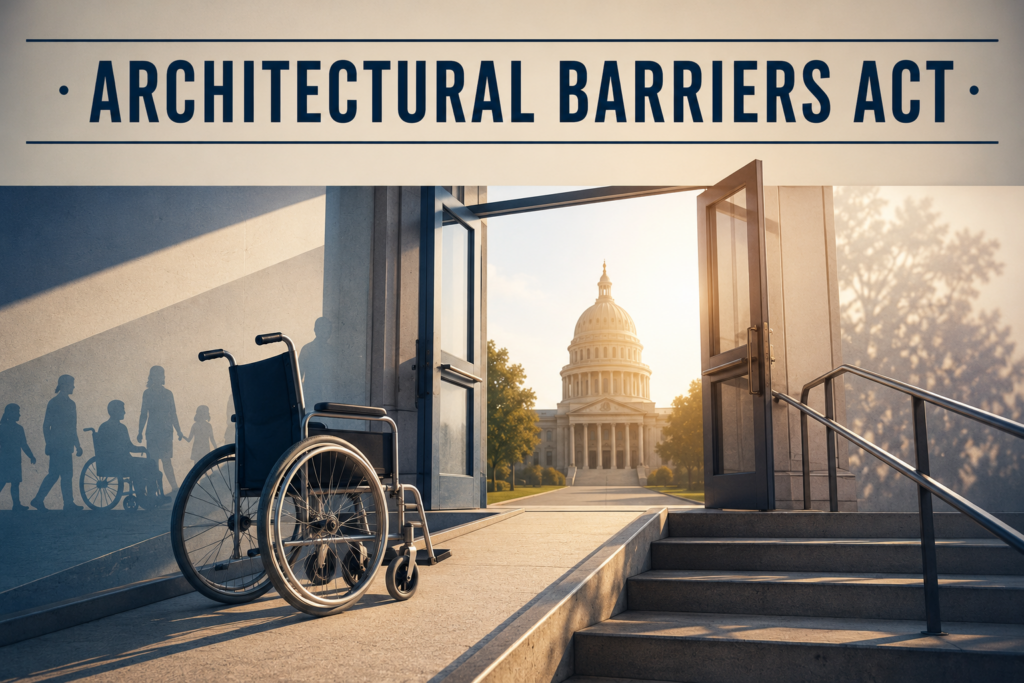
The Architectural Barriers Act: The Law That Opened America’s Doors
August 12, 1968 marked a turning point in disability rights history. On that day, President Lyndon B. Johnson signed the Architectural Barriers Act (ABA) into law, becoming the first federal law to require that certain public buildings be accessible to people with disabilities.
Today, ramps, elevators, accessible restrooms, and automatic doors are common features in many public spaces. But before the Architectural Barriers Act, these features were far from standard. Many people with disabilities were unable to enter federal buildings, visit government offices, or access important public services simply because the buildings themselves were not designed with accessibility in mind.
The Architectural Barriers Act was one of the first laws to recognize an important truth: people are often excluded not because of their disabilities, but because of barriers in the environment.
A Movement Toward Inclusion
Before 1968, accessibility was rarely considered during the design and construction of public buildings. A person who used a wheelchair might not be able to enter a post office, courthouse, Social Security office, or other federal facility. Stairs without ramps, narrow doorways, and inaccessible restrooms created unnecessary obstacles that prevented many people from fully participating in everyday life.
One of the driving forces behind the law was Hugh Gallagher, a congressional staff member who used a wheelchair after contracting polio. After experiencing inaccessible government buildings firsthand, Gallagher helped draft legislation that would require accessibility to become a standard part of building design rather than an afterthought.
His work helped shift the conversation from changing people to changing environments.
What the Law Did
The Architectural Barriers Act requires that buildings designed, constructed, altered, or leased with federal funding be accessible to people with disabilities.
The law applies to many federally funded facilities, including:
- Federal office buildings
- U.S. Post Offices
- Veterans Affairs hospitals
- Federal courthouses
- National parks and visitor centers
- Certain schools and housing developed with federal funding
Although the law focused only on federally funded buildings, it established an important principle: accessibility should be built into public spaces from the beginning.
Building the Foundation for Future Disability Rights
The Architectural Barriers Act was only the beginning.
It helped pave the way for many of the disability rights protections we rely on today, including:
- The Rehabilitation Act of 1973, which prohibited disability discrimination in federally funded programs.
- The Education for All Handicapped Children Act of 1975 (now the Individuals with Disabilities Education Act), which expanded educational opportunities for students with disabilities.
- The Americans with Disabilities Act (ADA) of 1990, which extended accessibility and anti-discrimination protections across employment, transportation, public accommodations, telecommunications, and state and local government services.
Together, these laws transformed accessibility from an exception into an expectation.
Accessibility Benefits Everyone
Many of the accessibility features we use every day were originally designed to remove barriers for people with disabilities.
Curb cuts help parents pushing strollers and travelers pulling luggage. Automatic doors make it easier for delivery workers, older adults, and anyone carrying heavy packages. Elevators and accessible entrances improve access for countless people beyond those who identify as having a disability.
Accessibility is not a special accommodation—it is good design that creates communities where everyone can participate.
Continuing the Work
While significant progress has been made since 1968, accessibility is an ongoing commitment. New technologies, buildings, transportation systems, and digital spaces must continue to be designed with inclusion in mind from the very beginning.
At the Advocacy Network on Disabilities, we believe that accessibility is about more than meeting legal requirements. It is about ensuring every person has the opportunity to participate fully in their community, pursue their goals, and live with dignity and independence.
As we recognize the anniversary of the Architectural Barriers Act, we celebrate a law that helped open doors—both literally and figuratively—and we reaffirm our commitment to building communities where everyone belongs.
Working for a world where everyone belongs.