
The Tech Act of 1988: How Technology Opened New Doors for People with Disabilities

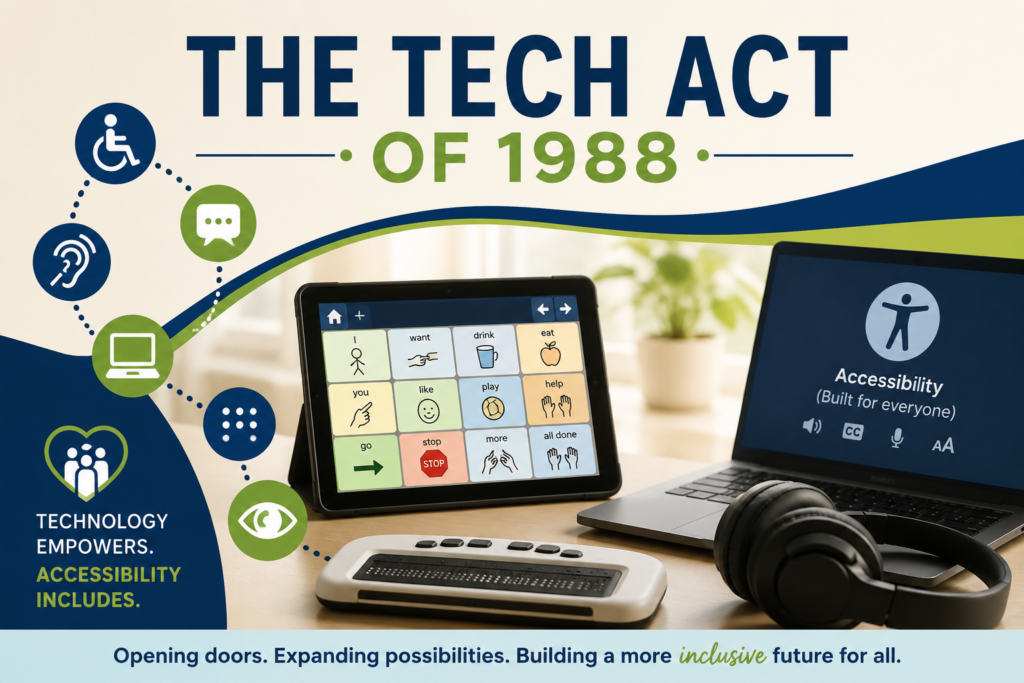
On August 19, 1988, President Ronald Reagan signed the Technology-Related Assistance for Individuals with Disabilities Act, better known as the Tech Act. While it may not be as widely recognized as the Americans with Disabilities Act (ADA), the Tech Act changed lives by helping people with disabilities gain access to technology that supports independence, communication, education, and employment.
The law recognized a simple but powerful idea: the right technology can remove barriers and create opportunities.
A New Way to Think About Disability
Before the Tech Act, many people with disabilities struggled to find or afford assistive technology. Even when helpful devices existed, families often didn’t know where to find them, how to use them, or how to pay for them.
As technology advanced in the 1980s, Congress recognized that access to these tools should not depend on where someone lived or how much money they had. The Tech Act helped states build programs that connected people with the equipment, training, and resources they needed to live more independently.
The law marked an important shift in thinking. Instead of asking what a person couldn’t do, it focused on providing the tools that could help them succeed.
What Is Assistive Technology?
One of the Tech Act’s most lasting contributions was introducing the term assistive technology into federal law.
Assistive technology includes any device, equipment, or product that helps a person with a disability increase or improve their ability to perform everyday tasks. These tools can be simple or highly advanced, but they all share the same goal: helping people participate more fully in school, work, home, and community life.
Examples include:
- Speech-generating communication devices
- Screen readers for people who are blind or have low vision
- Hearing aids and captioning technology
- Power wheelchairs
- Alternative keyboards and computer adaptations
- Adaptive eating utensils
- Voice recognition software
- Smart home technology
Today, many accessibility features built into smartphones, tablets, and computers are considered forms of assistive technology.
What the Tech Act Accomplished
Rather than purchasing equipment directly for individuals, the Tech Act provided federal funding to every state to develop assistive technology programs.
These programs help people:
- Learn about available technology
- Try devices before purchasing them
- Borrow equipment
- Receive training and technical support
- Explore financing options
- Connect with local resources
By creating statewide networks of support, the Tech Act made assistive technology more available to people of all ages and disabilities.
Building on the Disability Rights Movement
The Tech Act did not stand alone. It built on earlier disability rights laws that expanded access and opportunity.
The Architectural Barriers Act of 1968 made federally funded buildings more accessible.
The Rehabilitation Act of 1973 prohibited discrimination in federally funded programs.
The Education for All Handicapped Children Act of 1975 strengthened educational opportunities for students with disabilities.
Just two years after the Tech Act, the Americans with Disabilities Act (ADA) extended civil rights protections to millions of Americans with disabilities.
Together, these laws helped create a society where accessibility includes not only buildings, but also communication, education, employment, and technology.
Why the Tech Act Still Matters Today
Technology continues to shape the way we learn, work, communicate, and connect with others. For many people with disabilities, assistive technology makes it possible to live more independently, pursue education, build careers, and participate fully in their communities.
Many accessibility features that benefit everyone today—such as voice assistants, speech-to-text, closed captions, predictive text, and screen readers—have become part of everyday life because society increasingly recognizes the importance of inclusive design.
As technology continues to evolve, accessibility must remain a priority so that innovation benefits everyone.
Continuing the Work
At the Advocacy Network on Disabilities, we believe that technology can be a powerful tool for inclusion. When people have access to the right supports, they have greater opportunities to learn, work, communicate, and live independently.
The Tech Act reminds us that accessibility is about more than removing barriers—it is also about providing the tools that help people reach their full potential.
As we recognize this important milestone in disability rights history, we celebrate the progress made over the past four decades while continuing to advocate for a future where technology is accessible to everyone.
Working for a world where everyone belongs.