
Why the ADA Amendments Act Still Matters
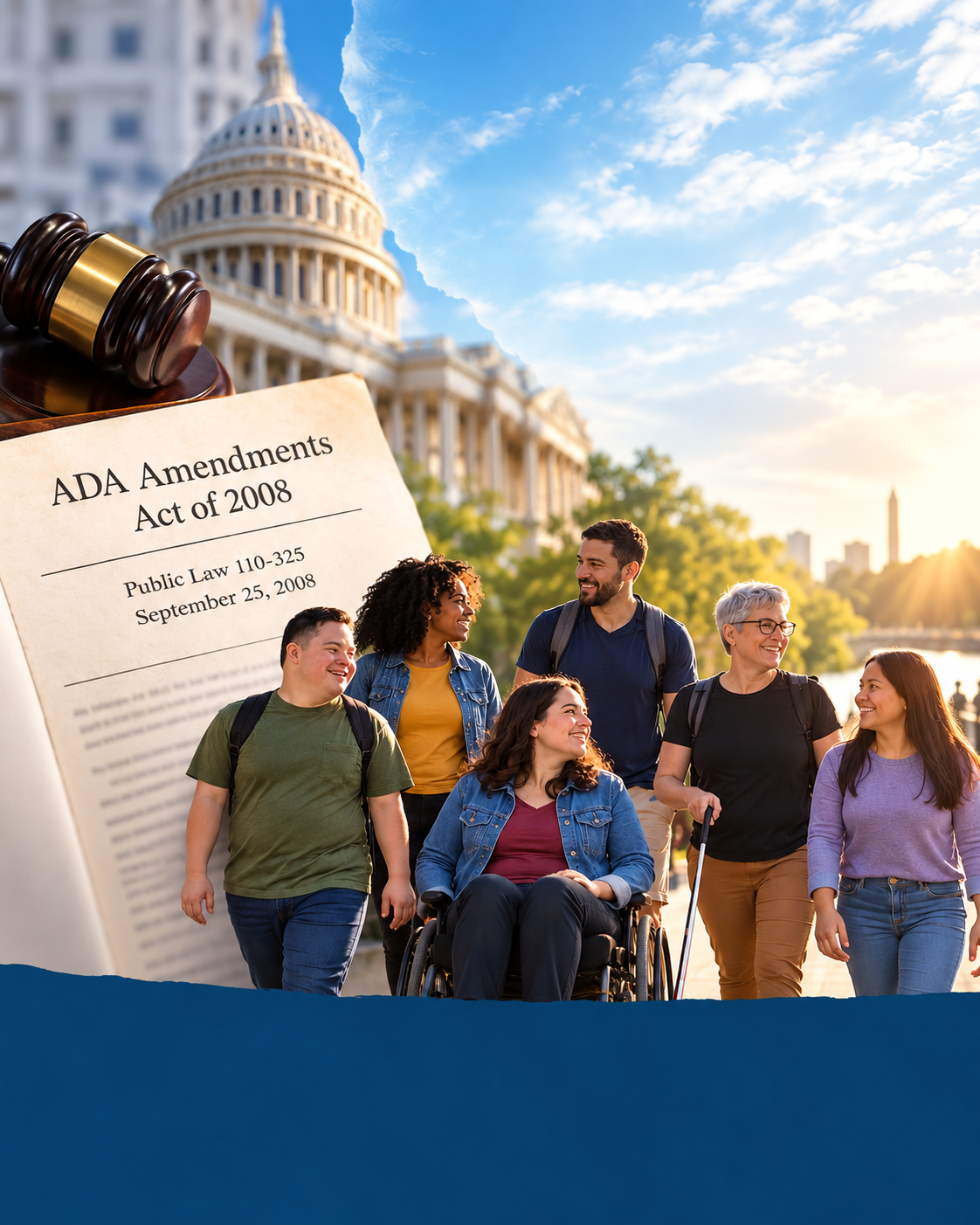
On September 25, 2008, President George W. Bush signed the ADA Amendments Act (ADAAA) into law. The law took effect on January 1, 2009, and strengthened one of our nation’s most important civil rights laws for people with disabilities, the Americans with Disabilities Act (ADA).
The ADAAA did not create a new disability rights law. Instead, Congress passed it to restore the broad protections of the original ADA, which became law in 1990. Over the years, several court decisions had narrowed the meaning of “disability.” This made it harder for some people with disabilities to receive protection under the ADA.
The ADA was created to protect people with disabilities from discrimination and support equal opportunity in employment, government services, public places, transportation, and communication. But after the law passed, courts began using a narrower definition of disability than Congress intended. Congress pointed to Supreme Court cases such as Sutton v. United Air Lines, Inc. and Toyota Motor Manufacturing, Kentucky, Inc. v. Williams as examples of decisions that made it harder for some people to qualify for protection.
This created a serious problem. Instead of focusing on whether a person had experienced discrimination, too much attention was being placed on whether the person met the legal definition of having a disability. People sometimes had to spend significant time proving they were “disabled enough” before the issue of discrimination was even addressed.
Congress responded by passing the ADA Amendments Act. One of its most important changes was making clear that the definition of disability should be interpreted broadly. The law also expanded the meaning of “major life activities.” These include everyday activities such as seeing, hearing, eating, sleeping, walking, standing, reading, concentrating, thinking, communicating, and working. Major bodily functions, including functions of the brain, nervous system, lungs, heart, digestive system, immune system, hormones, and reproductive system, are also covered.
The ADAAA also recognized that disabilities do not always affect people in the same way every day. Some conditions come and go. Others go into remission for periods of time. Under the ADAAA, a condition that is episodic or in remission still qualifies as a disability if it would greatly limit a major life activity when active.
Another important change involved medication, medical equipment, assistive technology, and other supports. A person might take medication, wear a hearing aid, use assistive technology, or rely on learned strategies to reduce the effects of a disability. In most cases, these supports should not be used to decide that the person does not have a disability. Ordinary eyeglasses and contact lenses are an exception.
The ADAAA also strengthened protections for people who experience discrimination because others believe they have a physical or mental impairment. Together, these changes reinforced an important principle. Determining whether someone has a disability under the ADA should not require a long and complicated process. The greater focus should be on whether discrimination occurred and whether an organization met its responsibilities under the law.
This matters because disability does not look the same for everyone. Some disabilities are easy to see, while others are not apparent. Some affect people every day, while others come and go. Many people use medication, technology, accommodations, or other supports to participate fully in everyday life. Using these supports does not erase a disability or a person’s civil rights protections.
The anniversary of the ADAAA is also a reminder that disability civil rights are not only part of our history. Laws continue to be interpreted, challenged, changed, and enforced, and those decisions affect the lives of people with disabilities today.
One recent example is Texas v. Kennedy, formerly known as Texas v. Becerra. The case began in 2024, when 17 states challenged updated regulations from the U.S. Department of Health and Human Services (HHS) under Section 504 of the Rehabilitation Act of 1973. Section 504 is another major federal civil rights law for people with disabilities. It protects people from disability discrimination in programs and activities that receive federal financial assistance.
In 2024, HHS updated its Section 504 regulations. The rules addressed several issues affecting people with disabilities, including discrimination in medical treatment, accessible medical equipment, accessible websites and mobile apps, and receiving services in the most integrated setting appropriate to a person’s needs.
The lawsuit changed after it was first filed. The states eventually narrowed their challenge, and by 2026 the case focused on the parts of the HHS regulations dealing with community integration. On September 23, 2026, a federal district court entered a final judgment setting aside those parts of the 2024 HHS regulations nationwide. The judgment followed a joint request from HHS and the remaining states involved in the lawsuit.
Understanding what this decision changed, and what it did not change, is important. The decision in Texas v. Kennedy did not repeal Section 504 of the Rehabilitation Act or the Americans with Disabilities Act. It also did not overturn the Supreme Court’s 1999 decision in Olmstead v. L.C., which remains an important legal precedent involving the unnecessary segregation of people with disabilities under Title II of the ADA.
The decision also did not end Section 504 protections for students. Eligible students still have protections under Section 504, including accommodations through Section 504 plans in schools. Instead, the court set aside specific parts of the 2024 HHS regulations related to community integration. Other parts of the 2024 HHS rule were not set aside by this judgment.
This distinction is important because Section 504 reaches many different federally funded programs and activities. The HHS regulations involved in Texas v. Kennedy apply to programs and activities receiving federal financial assistance from HHS. They are different from the U.S. Department of Education’s Section 504 regulations for schools.
There is an important connection between the anniversary of the ADAAA and what is happening today. The ADA Amendments Act became necessary because disability rights did not stop changing after the ADA was signed in 1990. Court decisions changed how the law was interpreted, and Congress later responded by restoring the broad protections it intended.
That history is a reminder of why disability civil rights still deserve our attention. Laws matter. Regulations matter. Court decisions and enforcement matter. Most of all, people with disabilities and their families deserve clear and accurate information about the rights and protections available to them.
On the anniversary of the ADA Amendments Act, we celebrate the progress made while recognizing that the work is not finished. Building communities where people with disabilities have equal access, equal opportunity, and a true sense of belonging remains an ongoing responsibility.
At Advocacy Network on Disabilities, we remain committed to working for a world where everyone belongs.
Sources
U.S. Equal Employment Opportunity Commission. ADA Amendments Act of 2008. Public Law 110-325. Approved September 25, 2008.
U.S. Equal Employment Opportunity Commission. Questions and Answers on the Final Rule Implementing the ADA Amendments Act of 2008.
U.S. Department of Health and Human Services, Office for Civil Rights. Section 504 of the Rehabilitation Act of 1973, Part 84 Final Rule: Fact Sheet. 2024.
U.S. Department of Health and Human Services, Office for Civil Rights. Section 504 of the Rehabilitation Act of 1973.
Disability Rights Education & Defense Fund. Texas v. Kennedy (formerly Texas v. Becerra): What It Is and How You Can Help Stop the Attack on Section 504. Updated September 23, 2026.